DROWNING OFF BIG SUR: A Tale of Stupidity and Survival

I’m not afraid of the water.  But perhaps I should be.  Let me explain why…

As a teenager I was really quite stupid.  Not ignorant—I knew a lot of stuff—just filled with the stupidity that makes teenagers do ridiculous things without a second thought for themselves or their loved ones, and gets them in deep trouble in the process.  Scientists say we can’t help this, that our brains aren’t yet formed enough until after age twenty to make truly rational decisions.  So we make big mistakes.

For me it was the Pacific Ocean.  I loved that ocean.  I still do.  And my boyhood buddy Louis, who was certified in scuba, showed me the ropes of diving with and without a tank in a high mountain lake (where both my legs cramped up and I barely made it back to shore, swimming in the icy waters of the Sierra Nevada in early spring).  Next Louis and I tested his equipment in a cove near Mendocino, north of San Francisco, where I donned my wetsuit and fins and headed out to check out the abalone fields, only to be tossed back upon the rocks by a wild wave.

The author about to do something very foolish

The author about to do something very foolish

And then came the day I drowned, off shore at the Big Sur.

Okay, truth be told, I didn’t actually drown, much to my own relief, but I came damned close.   And here’s how it happened…

I had just purchased a brand new neoprene wetsuit when everyone decided on a family road trip to the charming village of Carmel on the coast south of San Francisco, and then down toward San Simeon.  If you don’t know the Big Sur region, just take in the photo.  Drop-dead gorgeous scenery and a rugged coastline second to none.  We stopped at a public beach below Hearst Castle to stroll the tidal flats.  A nice big sign warned the public that no swimming was allowed due to treacherous currents and riptides.
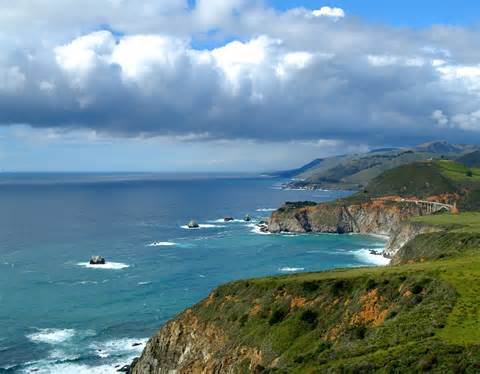
Big Sur

So I in my teen-age wisdom decided that this was the place to test out the wetsuit.  You know, not actually go swimming, just put it on, slip on some flippers, and paddle out a few yards to see how well it insulated against the cold waters.

Don’t worry, I told my justifiably worried mother, I’ll just go in up to my chest.

And then stupidity harvested its reward.  I was grabbed by a relentless riptide, a sucking undertow that drew me inexorably out, ever farther from shore.  My parents and my younger brother and sisters diminished to mere spots of dark on the sands as I was carried hundreds of yards out to sea.

My God, I thought, what do I do?

Now I had read the book on ocean diving, and knew the advice:  swim parallel to shore until you are out of the tide’s pull and you can then return to land.  So I swam south, parallel to the shore…and found myself dragged relentlessly back to where I began.  Then the same attempt heading north, and again I was forced back to the same spot.  Beneath the tips of my swim fins I could occasionally sense a submarine gravel bar deposited at the confluence of these treacherous currents.

In desperation I turned to swim farther out to sea, hoping to escape the vortex and then attempt swimming parallel to shore once again.  But I was lifted by the incoming waves and returned to the one spot where I was destined to remain.

The tiny figures on shore  were certainly being wracked by worry and helplessness. I know I was.

And then the revelation.  The harder I struggled to save myself from imminent exhaustion and doom, the more I realized that perhaps, just perhaps, my survival into adulthood wasn’t destined to be.  A peace came over me, an all-embracing acceptance of my fate.  I no longer fought the inevitable, I no longer wanted to kick with those fins to keep my head above water, and I allowed the surf to wash over me.  I was becoming one with the water, and it no longer seemed so frightening, its embrace so unwanted.

A strange image filled my consciousness.  A colorful beach ball.  Yes, my mind pictured a child’s toy, bouncing along the top of the waves, and I turned in the water to look out to sea and watched for the next big comber to roll my way, and at the very moment it lifted me up in passing I curled myself into that giant beach ball.  And surrendered to the moment.

I had no memory of the long ride in on that wave.  I became conscious again only once on shore, exhausted, face in the sand, wracked with coughing as I forced the seawater from my sinuses and lungs and my anxious family hovered over me.

I survived to tell the tale, and do other equally stupid things before my teen years had passed.

But whenever I hear of a tragic ocean drowning, I wonder if the victim felt what I did in those final moments.  Did that poor soul reach a moment of remarkable peace, where panic subsides, the struggle loses its allure, the fear quiets, and the unity with the ocean takes over?  It’s comforting to think so.  Scientists say the chemical makeup of our blood is akin to seawater.  I’m sure some of the latter still flows through my veins.

As I said, I’m not afraid of the water.  No, not at all, and perhaps I should be.  But I do take shorter showers than many.

Copyright 2013 Patrick W. O’Bryon
Posted in Travel Memoir, Uncategorized | Tagged , , , , , , , , , , , , , , , , | 7 Comments

HELLUVA WAY TO FIRST SEE EUROPE: The Seagoing Life’s Not for Everyone

I awakened to total silence.

I had fallen asleep to the raucous laughter, boozing, amorous groping and other fulfilling activities which mark a last night at sea with a shipload of grad students, all off for a year in Europe.  Some had already spent a junior year abroad.  Others, myself included, were excited about our first taste of the Continent. We were to reach the British Isles the next day at Southampton, then up the English Channel to Bremerhaven in Northern Germany.

Someone had borrowed a heavy wrench from a member of the crew.  In the closet of each cabin, right at carpeted deck level, were half-moon bulkhead covers.  Off came the bulky nuts from their bolts, exposing low crawl spaces allowing celebrants to crawl unimpeded from one cabin to the adjoining, linking three cabins in all.  Along the way bottles of alcohol, wine and beer were stashed in the crawlspace to lubricate the narrow passage.

So how had it come to this?  I had almost missed the boat.  Literally.

Saying my farewells to family less than two weeks before, I had taken the Western Pacific’s California Zephyr cross-country to Chicago, the former Twentieth Century Limited to New York’s Grand Central station, and planned to spend three nights in a high-rise hotel overlooking Central Park as the embarkation date approached.  Then came the fateful call.  The local draft board had denied my petition to leave the country.  I was to return immediately to the West Coast.

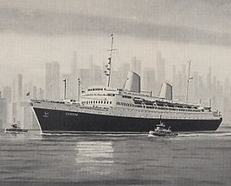
With a sorry heart I contacted the Fulbright people and told them I would forego my year abroad.  I cancelled my passage on the SS Europa, one of the last of the grand German liners making trans-Atlantic crossings. And I flew American Airlines back to San Francisco.  That evening, as I sat bemoaning my fate with family members, I got the news from an attorney friend of my elder brothers.  A reprieve from the draft board.  I had a year before I would be called up to fight in Vietnam.

Mad morning rush to catch a flight out of San Francisco.  No time to even say a second good-bye to family.  Back in New York anxious waiting in the hotel room.  Yes, my cabin booking on the Europa was history.  No, there were no more cabins available.  Yes, stay tuned for further developments.  By evening I’m pacing like crazy.  Show up at the docks in the morning, they said.  We’ll get you on board, they assured.   Oh my god, I worried.

So there I was dockside on the day of departure with the huge ship towering above me, my suitcase at my side.  The ship’s purser advises me to wait patiently, and I watch and watch as all the other passengers ascend the gangway and board.  Now they’re pulling up the gangway and loosening lines.  Now the officers are racing toward the crew gangway as crew members loosen the ship’s ties.  And finally, the purser appears again, grabs my suitcase and hurries me on board with the last of the crew as the ship’s whistles scream departure and the last of the heavy lines are freed of their moorings.

I watch the struggle of the tugs as they push and pull the huge vessel away from dockside.  I join the other passengers and help them wave to family and friends below.  Don’t worry, says the purser, we’ll find you someplace to sleep.  For the nine-day crossing.  We all salute the Statue of Liberty with our cocktail glasses and turn our gaze from the Hudson River to the open Atlantic.

Europa two (2)

I’m picturing myself taking up residence for the duration of the crossing in one of the lounges, back near a wall in an easy chair.  But there’s a reception for the Fulbright scholars on board, and a thirty-something German man asks my name and what cabin I’m in, and I share my dilemma.  He comes back shortly, having spoken to the ship’s purser, and tells me that he is the Fulbright representative on board, and he offers the shared use of his private cabin.  All the other students are four to a cabin, and I find myself having just one roommate.  The only proviso:  he reserves the hour from nine to ten for planned “private” meetings with girls.  No knocking or drop-in cabin calls during the restricted hours.  Ten-thirty to eleven-thirty is to be my hour to use as I please without interruption.

And so the Atlantic crossing went:  introductory classes on German customs in the morning up top in “Die Taverne,” deck chairs and various pursuits in the course of the days, plenty of lifeboat drills, dancing, parties both  public and private, and no end to food and drink and recreational pleasures.  There was a long day and night of stormy North Atlantic seas, with paper bags stationed thoughtfully the length of every hallway, and most passengers holed up in their cabins wishing the world would end.

Until that night of the grand farewell party.  Since I wasn’t much of a drinker (I kept up by emptying my bottomless beer glass into fellow party-goers’ mugs the moment they were off dancing or otherwise occupied), I wasn’t as stupefied as most.  At some moment I just crawled up into my upper bunk and fell asleep to the constant din around me.

And awakened to silence.  The incessant rumble of the ship’s engines, our constant companion over the long days and nights of the voyage, was gone.  My watch indicated just past four a.m.  The cabin was empty.  The hallway outside was empty.  I went up on deck, encountering no one, and found a sea that was more than full.  To the far horizon in all directions boats and ships of every description bobbed in place on choppy seas.  Under overcast skies an armada seemed to hover in the chop, their running lights blinking in the haze of pre-dawn hours off the coast of Britain.

A fellow grad student,  Mike, whom I had befriended in the past week, stood at the railing, his eyes scanning the waters.  He told me the story.

After midnight he and a co-ed had strolled the fantail of the ship and seen a crew member lower himself over the side, just above the screws as the ship plowed its way toward port.  No sooner had the sailor dropped from sight then Mike and his companion raced to the railing, only to see the man clinging desperately to the edge, his body hanging into the blackness and certain death below.  The would-be despondent suicide had changed his mind at the last moment.

Mike had dropped to the deck and reached through the scuppers to grab the man’s wrists, and his friend ran for help.  There was no crew to be found, so she made her way to the bridge to convince them to stop the ship and come aid the rescue.  But no one was manning the controls.  The duty crew had apparently also decided to celebrate the last night at sea, and the ship appeared to be steering itself.

Mike’s grip on the sailor’s wrists had ultimately weakened and failed, despite his very best efforts and the entreaties of the doomed man.

And then, finally, when too late, the alarm went out, the ship had slowed to a stop (it takes quite a distance to stop a large vessel), and the search for the body began.   It was soon joined by every fishing vessel and ocean-going  ship in the vicinity.  No one survives those cold waters for more than a few minutes, we were told.  We sat silently for hours, only the cries of gulls marking the passing of time.  Then the engines commenced their rumble, and the Europa plowed on toward Europe.

Postscript:  Months later Mike ran across mention of the incident in a Hamburg paper.  An official inquiry had found no fault in the crew’s or shipping lines’ behavior.

Europa one (2)

I thought of a comment I heard from a crew member that damp morning as we huddled on deck, watching the futile search: “We usually lose one or two along the way.”  I’m sure he hoped to make us feel better.

Copyright 2013 Patrick W. O’Bryon

Posted in European Travel, Travel Memoir | Tagged , , , , , , | Leave a comment

CAT AND MOUSE SURVIVAL AT THE PORT OF STOCKTON

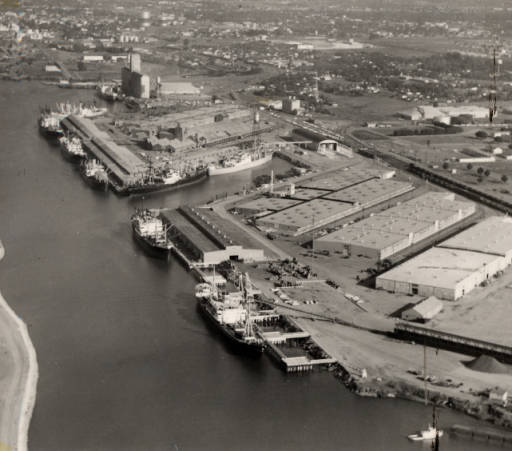
Imagine being fresh out of high school in the 1960’s and ready for college, inspired by a well-traveled father with a love for the great wide world, and snagging a job at an international port.  My duties consisted of spending the day slipping in and out of warehouses and along the docks on a three-wheeled scooter as I delivered mail and bills of lading to huge freighters and Navy ships.

Inland Port of Stockton in the '60's

Inland Port of Stockton in the ’60’s

I was seventeen going on eighteen, and I became the Port of Stockton messenger.   Starting at eight every morning I entered the mail room, sorted through the undelivered mail and newly processed shipping forms, then organized them for warehouse destination and the ships in port for the day.   I scheduled with special care so that at the end of my other deliveries I could use the extra time to lose myself on board the ships.  Once the paperwork was in order, I left the mailroom and mounted up in the cab of my yellow Cushman three-wheeler.  Time to shoot around the port from dock to dock, ship to ship.  A new run every hour on the hour.   I loved it.

Sort of like this..only yellow and in its better days

Sort of like this..only yellow and in its better days

And I was good at my job.  Okay, truth be told, I did once fail to recognize a Libby Foods bill of lading and stacked it inadvertently in the bin with the nearly-identical Navy invoices.    The next morning a shipping clerk took me aside to explain quietly that an ocean-going vessel had just spent an extra night in port, at the cost of thousands, all due to a seemingly missing shipment.  Luckily for me, he had taken pity and personally assumed the blame for the misfiled bill, and I kept my job.

It was the massive freighters that enthralled me:  huge, oily, filthy ships, reeking of diesel or molasses, rust and neglect.  I climbed the gangway to meet friendly crew who understood little English. Mail in hand, I had orders to seek out the captain and deliver to him personally.

But to get to his quarters, I always found the most circuitous routes, ambling down gangways and descending ladders into the bowels of the ships, smelling the raw stench of bilges or the glistening oil of well-loved engines.  I loved  the foreign languages of the crew,  the exotic melodies coming from the cabins, the stickiness of the decks of the molasses ships, the risqué pinups decorating the ship’s passageways.  If you haven’t smelled a molasses freighter on a hot summer’s morning as temperatures already reach into the 90’s, you haven’t lived the life of Stockton’s inland port in the ’60’s.

Once found, the captain of the ship was usually some unkempt type who greeted me with warm regard and offered me a beer at nine in the morning.  His tilted captain’s cap was the only sign of rank in an otherwise slovenly uniform of baggy trousers with suspenders and filthy wife-beater.  Over there—he gestured toward a careless stack of “dead soldiers” polished off over night—there might  be one in the fridge with some life still in it.  Not tempted, but curious, I examined the empties labeled with exotic foreign names of other ports of call. Then, when I politely declined once again,  he reached for a bottle of whiskey and toasted me before taking a slug.  Ah, a world-weary traveler’s breakfast.

I was in my element, an exotic world far from small-town life.

Freighters at the Port of Stockton

Freighters at the Port of Stockton

The Cushman was fun.  Its covered cab protected me from the worst of the sun’s glare.  Its slanted front windshield offered a good view of the road ahead.  And it had zip when I had to move quickly.  And I soon learned that moving quickly was part of the job, because the longshoremen on forklifts deftly twisting and turning about the long, dark and stuffy warehouses thought  the port messenger was fair game.

I would scoot from the baking heat into the dark recesses of a warehouse, my senses alert as I passed looming stacks of crates or cotton bales, for I knew that at any moment an attacker lay in wait, idling in the shadows and ready to spurt out into my path with the clear intent of impaling my vehicle.

I was quick.  The first time it happened I thought it was an accidental near-collision, although the dockworker laughed mightily and offered me a special salute with his middle finger.  The next time I almost ended up a shish-kabob, I realized that this daily threat was part of the job, and decided to make the best of it.  “You may want to watch out for the forklifts,” the boss had suggested on my first day.  Now I knew what he meant.

So I gathered my wits, and my forays into the dockside sheds became a game of cat and mouse, where I was the nimble mouse, ever alert to the perils.  I would race along, then dodge behind the bales and spin around the stacks near the wall and then accelerate out a gap in the long rows where I was least expected, only to be pursued by a forklift or two and a spate of cursing at having eluded the trap.  Once parked at each of the dock offices I was on safe grounds, for the foremen were polite and non-threatening.  But back in the Cushman the game was on, and by the end of the day I prided myself on my driving dexterity and success at eluding the increasingly unfriendly dockworkers.  They wanted their prey.  This kid was making a fool of them.

It was a very hot day about one a.m.—I had just had my lunch break and begun the mid-day run—when I moved cautiously along a very long warehouse without incident and breathed a surprised sigh of relief.  As I shot out the huge doorway into the glaring sun and accelerated I was momentarily blinded.  And then it happened.  The Cushman rose up at the front with no warning, the windshield came crashing in on me, and I was thrown backwards, my eyeglasses ending up behind me.

I drew myself together and gathered my wits.  The  sleekly slanted front of the Cushman Haulmaster was now deeply indented.  It had met an inch-and-a-half steel cable stretched from a dock piling on my right to a tractor off to my left, just at the height of the steering column.  The cable hadn’t given way, so my valiant three-wheeled ride had.  I cleared my head and looked around, but not a soul was to be seen as the heat radiated from the baking pavement.  The Caterpillar tractor stared at me in all innocence.

My head hurt where it had impacted the flying windshield, and as I limped back to the port offices I played out my imminent firing in my head.  I had wrecked the Cushman.  My job for the summer had come to an inglorious end.

Imagine my  surprise to find great concern from the boss.  “No flags on the cable?” he asked.  “No one around to help?” he wondered.  “Need to see a doctor?” he inquired, with the obvious implication that nothing of the sort would be needed.  “Of course, you still have your job,” he assured me.  “Do you have a car you can drive for the rest of the summer?”

I was too naive to think lawsuit.  He was too sharp not to worry about one.

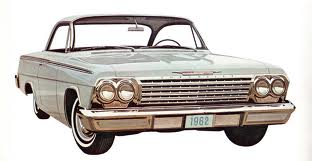
Until fall and my first college semester arrived I drove from dock to dock in the family’s ’62 Chevy.  My own $800  Jaguar XK-140, which overheated at the thought of a summer’s day, hadn’t lasted a week in the Stockton dockside swelter.  Now I drove around the warehouses, not through them, and made my deliveries to the offices on foot as the car engine idled in the stultifying heat.  But I still enjoyed getting lost on the freighters.

No explanation was ever given for the cable linking tractor to dock piling.  In fact, I was told it was gone by the time anyone surveyed the scene.  But I knew.  The nimble mouse had  been too embarrassing for the aggressive cats.  He had to be put in his proper place.  And he was.  A Chevy Bel-Air.

Chevy Bel-Air

Copyright 2013 Patrick W. O’Bryon
Posted in Travel Memoir, Uncategorized | Tagged , , , , , , , , | 11 Comments

FINDING A HOME IN YOUR HEART…a plea on behalf of abandoned animals

Silver and Solo, abandoned brothers

Silver and Solo, abandoned brothers

The microcosm:  A neighbor at the head of our cul-de-sac, whose two-acre property fronted a busy country road, obviously thought that letting his cats roam free and breed freely was nature’s way. When he lost the place to foreclosure, I was secretly delighted, for the task of picking up the feline roadkill on my morning walk had left me emotionally drained and furious at my inability to change his and others’ ways.

Two fosters who found their forever homes

Two fosters who found their forever homes

Once this neighbor and his family moved out we found sixteen cats, two with kittens, all  abandoned to their own devices, and one by one we captured them and had them spayed or neutered.  Safe and loving homes were found for most of the kittens.  Eight of the deserted felines became the adoptees of our cul-de-sac, and they continue to bring smiles of pleasure with their boisterous play on a daily basis.  Neighbors gather to discuss the cats latest antics.  And if one of the communal cats isn’t seen for a day we gather on the street to search out the missing beastie.

A cat's dream

A cat’s dream

Once a neighbor’s dogs from the five-acre parcel to our east cornered Silver and tossed him violently in the air, and he ran into the brush of our land and was missing overnight, despite hours of searching and calling.

In the morning, as I discussed where we should search next with my neighbor Robin, another of the cats, Mia, wandered down our drive and bent over to stare into the culvert beneath the driveway, alternately looking at me and then into the culvert.  A quick check confirmed that Silver was hiding in the dark tunnel, and soon several neighbors gathered to determine how best to get him out so that he could be checked by the vet.  As we made preparations, with a cat carrier at one end and a soccer ball to push down the tube to encourage him to enter the carrier, out he wandered to check out the fuss and activity.  Happily, he was uninjured in the scrap with the dog pack.

IMG_3348

Every morning I am welcomed on my feeding rounds by racing, tumbling feral cats eager for companionship, now that they know some humans actually can be trusted to share their lives and care for their well-being.  If we didn’t already have a houseful of animal companions we would take each and every one in to give it the kind of home it deserves.  The photos in this post are all of cats we have fostered over the years.  Others have never left our care.

Ivy, a shelter cat who found a permanent, loving home

Ivy, a shelter cat who found a permanent, loving home

The macrocosm:  This is “kitten season,” and in every community hundreds, even thousands of unwanted kittens are being born, most of whom will never know the pleasure of a warm, loving home.   Many will breed again and again if they make it to adulthood, furthering the cycle of pitiful, painful lives of neglect.  Most others will end up abandoned, then ultimately killed in the wild or euthanized in shelters.

Rescue Kittens

Rescue Kittens

Today on Mother’s Day, consider adopting a kitten or puppy, consider giving a loving permanent home to a full-grown cat or dog from the shelter.  Or perhaps you can find room to foster an adult or baby animal?   The adult companions may well have been separated from a once-loving household by death or economic trouble.  Or they may have strayed too far and couldn’t find their way home.  They don’t know what happened to the family they lost.  After all, they did everything to please those families.  Can you find room to put pleasure in their lives?  I guarantee they will return the favor.

Go ahead...take a couple...they will thank you for it!

Go ahead…take a couple…they will thank you for it!

Posted in Animal stories, Uncategorized | Tagged , , , , , , , , , , , , , , | 8 Comments

OF COURSE IT’S SAFE TO DRINK THE WATER…An Adventure in Old Spain

The whole second half of our Spanish journey hadn’t gone exactly as planned, so why was I surprised to wake up to a smiling physician about to inject me in the butt with a huge hypodermic needle?

After all, only days before I’d barely escaped spending time in the company of Franco’s civil guards.  You remember, the ones with those shiny tricorne hats?  The guard at the border control from Morocco mistook a lump in my overcoat for a smuggled block of hashish.  He tapped my coat pocket impatiently with his riding crop, and relished his first drug bust of the morning.  But when I withdrew an innocuous little German-Spanish dictionary and gave him a cheerful smile, his look showed such disappointment and malice that I hurried on through customs, expecting any moment to be called back for who-knows-what kind of interrogation.  Franco’s men weren’t all that forgiving.

civial guards

And the next morning, just before sunrise, when I can’t face the disgusting condition of the men’s toilet in our cheap Algeciras hotel, I sneak into the empty ladies’ facility, only to be trapped when an early-rising señora knocks impatiently on the locked door.

So I do what any clever traveler would do.  I respond in my finest Spanish falsetto.  “Un momento,  por favor!”

Faking a woman’s voice proves a big mistake.  The new arrival doesn’t leave her post.

I might have escaped through the small window, but the three-story drop to the ground below discourages such an obvious solution, so I decide to wait her out.  But she offers me no chance for making an exit with some shred of dignity intact.  She knocks again, more impatiently than ever.

Another woman soon joins her in line.  And then another.  In fact, a congress of angry women has now gathered at the door, taking turns calling out, first voicing their concern at what is keeping me so long locked in the tiny chamber, and finally expressing displeasure at this rude “woman” hogging the floor’s single facility.

Gathering up my courage to face certain embarrassment, I burst forth and without a single glance to either side race through the gauntlet of furious woman as a crescendo of angry voices batters my back with Spanish insults.  Happily my knowledge of the language is far too limited to grasp the verbal barbs slung my way, but I get the message.

So with my traveling buddy Mike laughing all the while, I slink out of the hotel as quickly as possible, and we make our way to the lovely Atlantic town of Cadiz.

Cadiz

You’d love Cadiz, so go see it at your next opportunity:  brilliant white-washed buildings cascading to the sea, warm friendly citizens, laughing children kicking soccer balls around the narrow streets or playing toreador and bull.  And a brilliant blue ocean splashing at the city’s feet.

The hotel is a notch or two up the “luxury” scale from the previous night, and the restaurant is filled with happy diners and inviting.  We both choose the special—pork chops in rich brown gravy, and they taste great.  But then, having devoured pretty much the entire thing, I see the last vestiges of very pink, very raw pork clinging to the bone.    Mike checks out what remains of his entrée, only to find the same thing.  We have just consumed raw pork.  Aarrgh.

With visions of trichinosis wrestling with our minds, we wander the evening streets of Cadiz, pondering our fate.  Remember, this was back in the days before one simply grabbed the smart phone to instantly access medical data, so we were forced to rely on our own recollections of just how the parasitic roundworm was going to be our undoing.

We pass a recently killed rat in the middle of the street, hapless victim of some passing vehicle I’m sure, but to us in the moment a sign from the gods that we are soon to be dead as rats, as well.

Once back in our room, Mike excuses himself and returns minutes later to confess he’s forced himself to throw up the treacherous meal.  I recognize his wisdom and try to do the same, but for some reason I can’t get my fingers and my throat to cooperate, and despite a valiant effort I can not disgorge the pink pork.  My fate is sealed.  The clock is ticking.

(Now, I know what you’re thinking.  Why the hell didn’t he call a doctor?  Well, as grad students traveling on five dollars each a day, I hadn’t wanted to spend my meager funds on medical help.  I was young and strong, and budget-conscious.)

Alcazar in Seville

Now the next stop on our journey is the royal Alcazar palace in Seville, an Andalusian masterpiece of 12th-century Moorish architecture.  The Alcazar is resplendent with stunning rooms, lush gardens and splashing water basins and fountains.  After a day of sight-seeing and a nice walk through the olive groves surrounding the city, we take in a flamenco show and drink a bit too much sangria, then find our way back to the hotel.  Once back in my room, I realize I have no bottled water  to brush my teeth, so I go downstairs to the desk and ask about the tap water.

“Of course it’s safe to drink,” assures the desk clerk, “I’ve drunk it all my life!”

The next morning we board an express train to pass many hours crossing the great plains of Spain.  And then it hits: The clamminess.  The fever. The churning.  The nausea.  Oh my god, I’m dying of trichinosis!

While kilometer after kilometer of sun-drenched Spain races by, good buddy and Spanish-fluent Mike goes the length of the train in search of a doctor.  He returns with a very large, brightly-colored capsule in hand, and comforts me with having found a physician to treat my ills.

“What’s that?” I mumble in distress, “It looks like it would choke a horse.”

“It’ll work just the same,” Mike assures me, admitting that it is indeed a veterinarian who has offered pharmaceutical relief.

Nevertheless, his fine work is wasted on me.  I can’t keep the damn thing down.

Benidorm

And then we’re on the stunning Costa del Sol, where long beaches and high-rise hotels embrace the azure waters of the Mediterranean.  I’m feeling better for a few hours, then once again the malady lays me low.  And while Mike is out enjoying the calamari and wine, the sandy beaches, perhaps the charm of Benidorm co-eds in bikinis, I cower in feverish misery in our hotel room.

Until Mike returns to find me passed out alongside the bathtub.

The hotel doctor is called.  He charges five bucks.  He shoots me full of antibiotic.  And comes back later in the day when I am feeling somewhat better to hand me a bottle of prescription pills and assure me that I have a waterborne bug, not trichinosis.  You’re not dying, he says, at least not yet.

He was right.


Copyright 2013 Patrick W. O’Bryon


Posted in European Travel, Travel Memoir | Tagged , , , , , , , , , , , , | 1 Comment

CONFESSIONS OF A BIGFOOT HOAXER: and How Mother Nature Turned the Tables

Before “reality TV” made them nightly magnets for ridicule and disbelief, Bigfoot sightings, alien visitations and the Loch Ness monster only appeared occasionally in popular magazines and newspapers.

In my favorite bookstore of my college days I stumbled upon Bernard Heuvelmans’ now-classic treatise, In the Wake of the Sea Serpent. Here was the first scientist to make a serious attempt at cataloguing unknown marine creatures based on historical sightings (see also his On the Track of Unknown Animals). Heuvelmans is now considered the founder of cryptozoology, the study of anecdotal reports and physical evidence of animals which have eluded more conventional scientific study due to either their scarcity, or their fictitious nature.

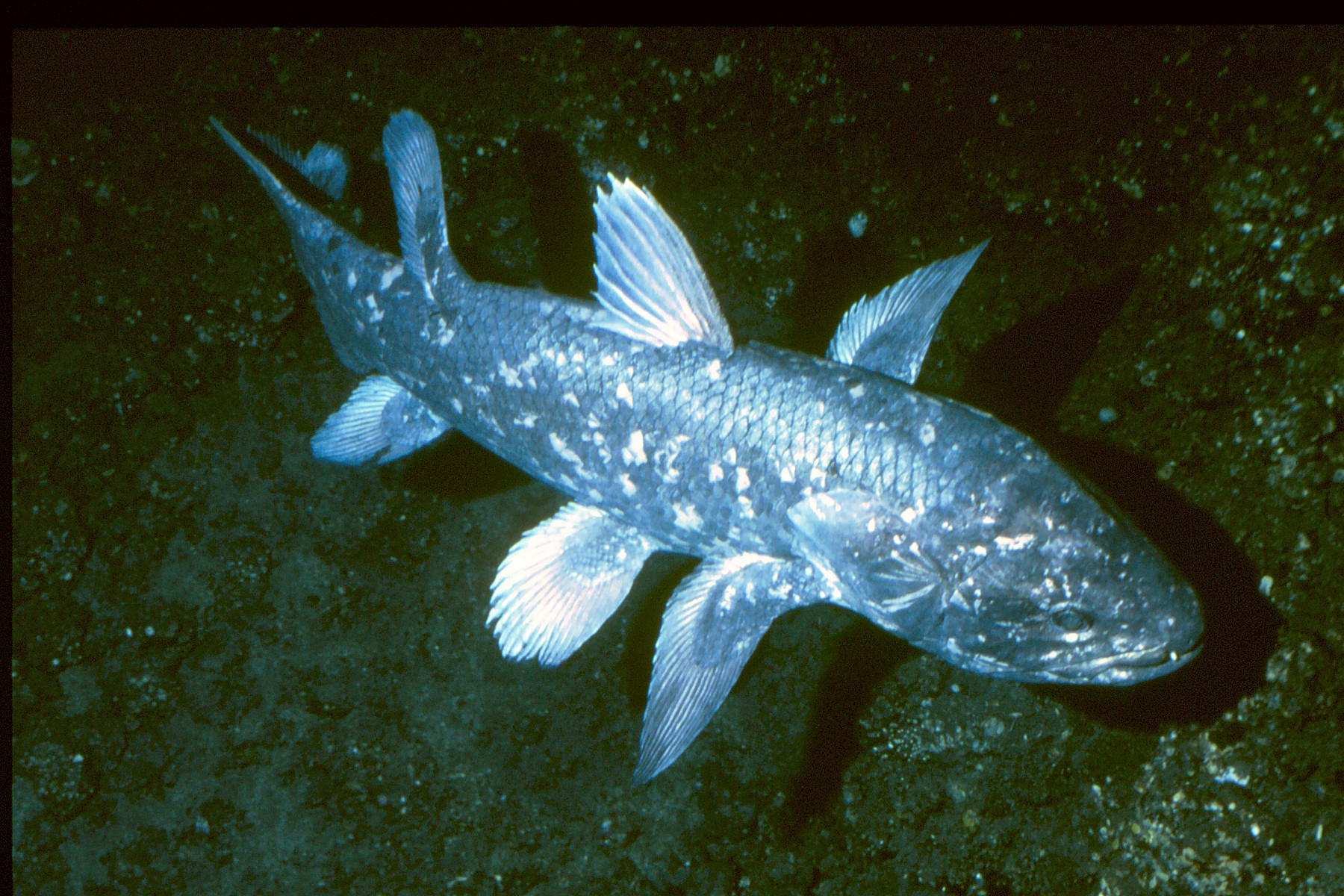
Coelacanth

Coelacanth

Just consider the coelacanth, a prehistoric fish thought extinct for tens of millions of years, which inadvertently “surfaced” in a fish market display in 1938 (and is now considered an endangered species), or the long-denied Giant Squid—thought to be the Kraken of legendary fame—now acknowledged to exist, or even the horseshoe crab, little changed over 450 million years, well, why not more of the same? What other mysteries are  yet to be uncovered?

My biology professor enthralled the lecture hall with his tale of an oceanography expedition from his grad school days.  Their research vessel was taking soundings above a deep water trench off the Chilean coast when sonar picked up the image of a huge creature in the shape of a plesiosaur, an extinct dinosaur of the sea.  The leader of the expedition put in to port and ordered the fashioning of a giant iron hook.  Returning to the deep water site, they baited the massive hook with the carcass of a cow and lowered it on a metal cable from a motorized winch on the stern.  For several hours they trolled above the underwater chasm as the grad students stared at the sonar screen. Abruptly a massive jolt shook the research vessel and they realized they had a strike.  The crew reeled back in the cable, only to find the beef-kabob missing, and the “hook” now a spiral of twisted metal.

Plesiosaur

Plesiosaur

Damn…now I was hooked.  I wanted to witness something amazing, too.

So when my sister who lived in California’s remote Alpine County told me that several of their local friends had reported mysterious objects rising and descending in the night sky from a distant desert valley in neighboring Nevada, I related the news to three college buddies. It was quickly agreed that a road trip was in order, the perfect opportunity to camp out in that desolate wilderness and watch for alien traffic. But then we learned that nighttime temperatures in that high desert location were dropping below freezing, we opted instead to camp out in Calaveras County along an abandoned narrow-gauge logging railroad known to one of my friends.

“Perhaps we’ll see Bigfoot, instead of aliens,” joked Maury.

Now anyone who knows me knows I’ve never had problems with friendly hoaxes and practical jokes. So I got to thinking: what if I cast in reinforced plaster some large footprints, sneak them along, and play fast and loose with the credibility of my friends? Great idea! I let Dave in on the prank, since I had to hide those impressive  casts in the back of his VW. But Maury and Todd were destined to be the targets of my evil undertaking.

So there we were, our two tents set up on the site of an abandoned railroad camp. As darkness descended on the woods we sat around the campfire exchanging stories and arguing the Vietnam war, and I sensed my moment of practical-joke greatness. Excusing myself to search for firewood, I found my way up the forest service road with flashlight in hand to a rutted pool of rainwater, found the plaster feet secretly hidden in the rocks upon our arrival, and laid out a nice pattern of footprints in the mud.

Satisfied with my work, I returned to the fire to announce in faux amazement that I had seen a depression in the mud resembling a large human foot! Genuine disbelief all around. No one wanted to leave the warmth of the fire.

So Dave gave it the needed impetus: “Come on, let’s check it out.”

With Coleman lantern and flashlights in hand, we returned to the site of the “sighting” and began a diligent search….and no one spotted a thing. I finally realized I would have to be the one to make out the muddy prints.

“Look, there! And there!”

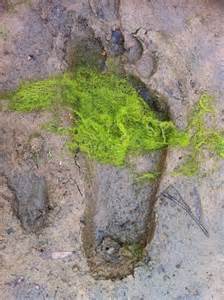
Bigfoot track

Once the depressions in the mud were revealed, all agreed without hesitation that here was truly proof of the elusive Sasquatch. And here another! And another! Some huge humanoid creature had stumbled around the pool, probably drinking from its muddy rainwater. And Maury and Todd determined that we should pack up our tents and quit our camp for more familiar territory…home. Despite my and Dave’s pleading for courage, they weren’t about to spend the night with such a large creature lurking nearby and probably observing us from the darkness at that very moment, so I came clean.

Trying my best to put a cheerful spin on the prank, I admitted to the hoax, confessing that I had created the footprints. There was a stunned silence. But Maury and Todd would have none of it. Oh, they believed now that it was a hoax, since Dave and I showed them the plaster casts. But neither believed I was the hoaxer, blaming it all instead on poor Dave, the co-conspirator but certainly not the evil mastermind.

“Pat would never do such a thing,” said trusting Maury.

In a mood of general suspicion all agreed we’d stay the night, after all.

I made my way up from our campfire to use an old, half-burned out privy we had righted sufficiently to suit our needs. As I went about my business I heard an odd and disturbing guttural sound coming from behind the outhouse.

“Knock it off, guys,” I said. “You’re not getting even that easily,” I warned. Again, the unusual sound, now directly to the rear through the charred hole at the back of the structure. “Forget it, it’s not working,” I let my buddies know. Silence.

I looked down toward the campfire., saw three bodies silhouetted by the flames. Hastily abandoning the privy, I stumbled down to join my friends, hoping against hope that nothing came lumbering after me. And once in the fireside’s warm embrace, I knew better than to try to tell them about the strange sounds I had just heard at my back.

I destroyed the bogus footprints in the mud before we left our campsite the next morning.

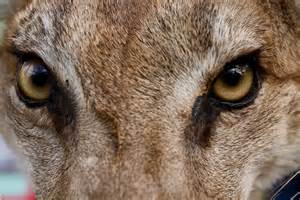
And a week later I asked a zoology professor what might make such a sound I had heard coming from behind the outhouse. “Curious mountain lion,” he replied.

mountain lion

Now let’s flash forward about ten years…

My wife and I are hiking in the high Sierra Nevada, our German Shepherd Tanya at our side. Returning from spending the day in a wilderness area near Union Reservoir, we stroll down a well-groomed trail between two tall stands of pine.

With a bound Tanya leaves our side and races a hundred feet ahead to stare intently at something she has seen. She doesn’t let out a raucous bark, as she normally does at pretty much any discovery. We peer down the trail, interested in her find.

And there, stealthily traversing the path from left to right, moves a large, hairy figure. Taller than any man despite its hunched profile, covered in shaggy reddish fur, the being strides quickly on two legs, obviously intent on reaching the shelter of the woods.  It does not turn its head in our direction. Tanya remains quiet, observing but showing no inclination to chase into the woods after the stranger.

We now race forward to where it disappeared from our sight, and see nothing amidst the growth of pines to our right. Nothing moves. Total silence. But Tanya’s ears remain alert as she stares, even after we encourage her to move on and we make our way down the path.

It might have been Maury or Todd, exacting a decades-old revenge for my college prank. But I doubt it. I suspect Bernard Heuvelmans would doubt it, too.

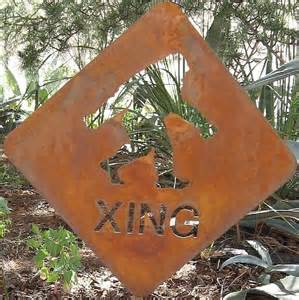
bigfoot crossing sign

Copyright 2013 Patrick W. O’Bryon

Posted in Animal stories, Short stories of the Paranormal | Tagged , , , , , , , , , , , , , | Leave a comment

LOOKING FOR (ITALIAN) LIFE AFTER FLORENCE?

Hundreds of you readers (well, two, to be precise) have asked for an alternative to Florence,  just in case they’re stuck driving circles around that lovely cultural center trying without success to break into the old town itself (see my last blog posting).

Bologna's Piazza Maggiore at nightfall

Bologna’s Piazza Maggiore at nightfall

If you don’t know Bologna (city, not luncheon meat), drive less than an hour north across the rich, green Appenine mountains to reach this urbane and welcoming historic city. (Overnighting suggestion:  Villa Campestri, situated in the gorgeous countryside along the way.)  When you arrive in Bologna, you’ll discover charm, culture, beauty, and half as much tourist congestion as you found elsewhere.

Don't settle for this

Don’t settle for this

My first experience there was less than welcoming, through no fault of the city.  My grad school buddy Mike and I were hitching down the Italian boot in February, and rain had drenched our clothing and our spirits.  We couldn’t catch a break as we tramped through town and mistakenly took a road that brought us to a bleak industrial area with only the occasional passing truck.  As night fell  we were rescued by a trucker who took pity on two sodden walkers stumbling alongside the road.  He deposited us at an outlying rail station, and the next local train took us over the mountains into Florence.  We missed out on all the wonders I’d heard about the city, and I swore I’d be back to see what I’d missed.

Years later my wife and family and I have returned numerous times.

Fontana del Nettuno on the Piazza Maggiore

Fontana del Nettuno on the Piazza Maggiore

Bolognese life revolves around the Piazza Maggiore, framed by San Petronio basilica (the stone facing for its façade never completed) and the Palazzo del Podestà (the medieval law court built in the 13th century and remodeled in 1484).  Directly across from the lively Neptune Fountain lies the tourist information office where you can pick up a city plan and a guide to the numerous cultural attractions of the city.  And just up the Via Rizzoli are two colossal leaning towers from the 12th century which were once among over two hundred which graced this imposing city.  If you’re feeling energetic, climb up 498 aged wooden steps to the top of the Asinelli tower for a panoramic view of the city.

DSC00424

Bologna is the heart of Emilia-Romagna, a rich agricultural region famed for Parmigiano Reggiano cheese and Modena balsamic vinegars, and that’s just for starters.

Funny story:  my wife wasn’t a big fan of Parmesan cheese, never having discovered just how delicious the genuine article is.  She’d been turned off by the American version shaken from the green can and never tried it again.  So we once sat in a restaurant in the little town of Parma, and she asked me to express to our waiter in my rudimentary Italian that none of the famed local cheese should be added to her meal.  Imagine the look we got from our male server.

Afterwards it occurred to me that the expression I had used–a mia moglie non piace il Parmigiano (my wife doesn’t like Parmesan)–can also express one’s distaste for any male citizen of Parma, il Parmigiano.  And then I understood that look from the waiter.  After all, could anyone not like the local cheese?

The Cheese (Il Parmigiano)

The Cheese (Il Parmigiano)

The man from Parma (Il Parmigiano)

The man from Parma (Il Parmigiano)

But…back to Bologna.  This city’s culinary offerings will leave you full but wanting more.  Two excellent restaurant choices are Mela, just off the main piazza, and Anna Maria, a trattoria a bit more challenging to find but always outstanding .  Ask your hotel clerk to make reservations and give you directions.  There is a daily market at La Piazzola and others scattered around the city center, and an enticing deli is never far from view.

DSC00397

Just wander freely up and down the arcaded streets. You’ll find plenty of inviting food stores and restaurants to lure you in. True Italian life and language is far more prevalent here than in the heavily-touristed city centers elsewhere.  And of course—since this is an actual vibrant city center—you’ll  find department stores, book boutiques, music stores and everything else for the shopper in you.

Bologna is a city made for living, not just touring.  We love the rich red and ocher buildings , surprising parks of green, and the numerous arcaded walkways where locals stroll with their dogs as evening falls. Watch for courtyards and enter unsuspected worlds of beautiful architecture.  The university is Europe’s oldest, so your evening walks will lead you past noisy bars with both student celebrants and music spilling out onto the side streets, giving the town a youthful vibe despite the obvious age and elegance of the surroundings.

Now get going.  Visit once.  You’ll be back.

Outdoor cocktails, olives and little sandwiches, enjoyed behind the Basilica

Outdoor cocktails, olives and little sandwiches, enjoyed behind the Basilica

Copyright 2013 Patrick W. O’Bryon

Posted in European Travel | Tagged , , | Leave a comment

HOW I LEARNED TO HATE FLORENCE…

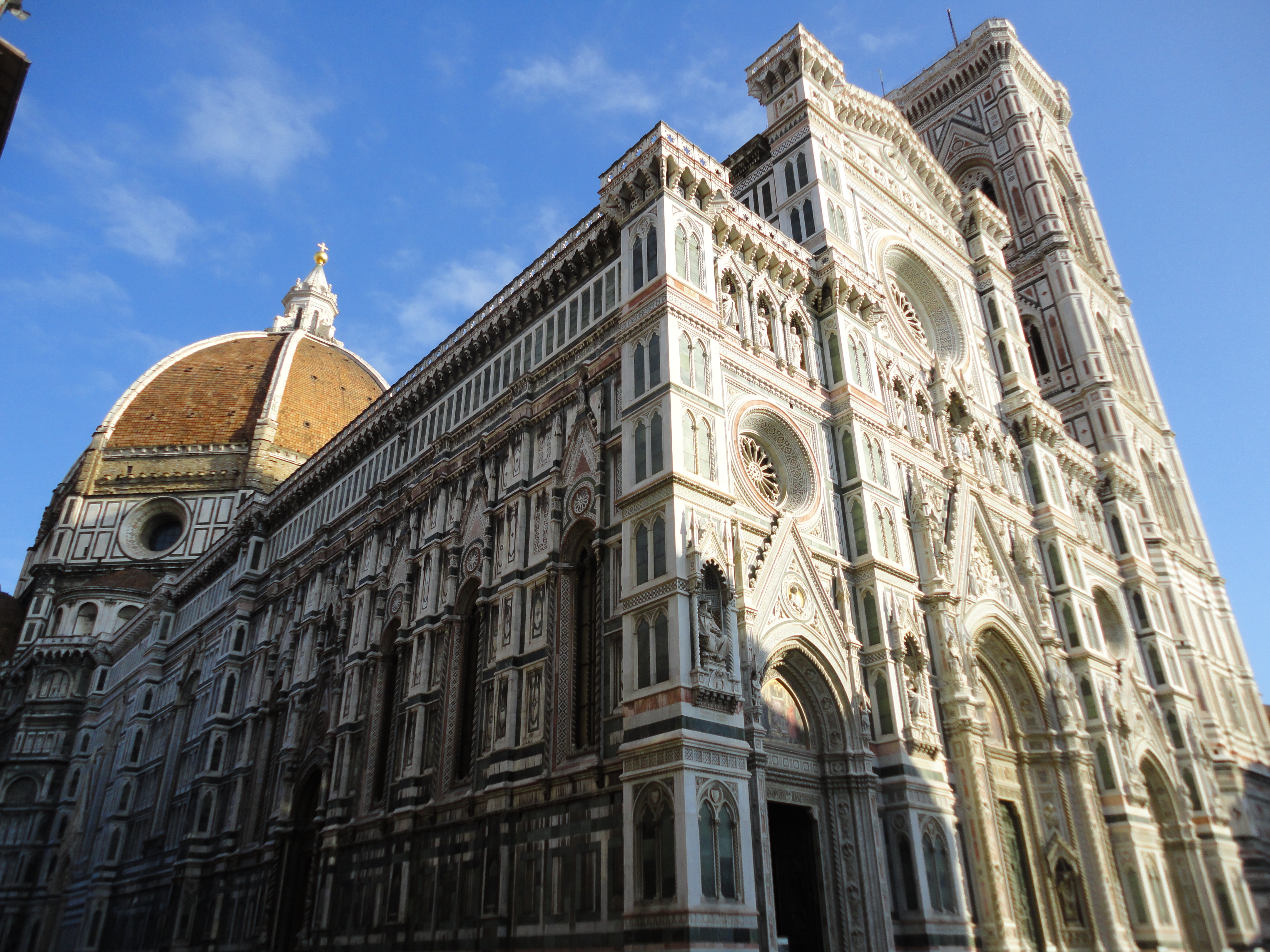
Before all you lovers of Italian culture build your own big bonfire and set me alight as a modern-day Savonarola, let me explain.  No doubt Florence deserves its reputation as a must-see destination, particularly for travelers discovering the beauties of Italy for the first time. And I’m not suggesting you avoid the city altogether.  See it at least once, and in detail.  After all, where else will you find such a beautiful and memorable setting?  Graced with splendid architecture, unrivaled art collections, sculpture, fascinating history, and, of course, Brunelleschi’s dome, it’s the “Cradle of the Renaissance,” right?

Duomo in Firenze

Duomo in Firenze

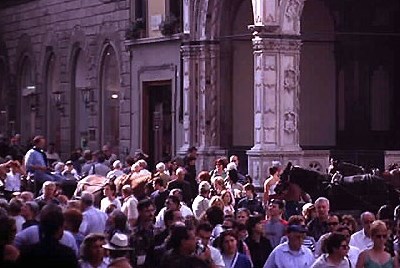
But unless you are lucky enough to visit in the true off-season, Florence also suffers from overwhelming crowds of tourists, streets congested with hawkers of the cheapest gew-gaws and knock-offs, limitless opportunities to eat run-of-the-mill food in restaurants where you will hear pretty much any language except Italian, and enough silver- or gilt-covered mimes posing as Dante to make you feel you’re in your own personal Inferno.

And then there’s the traffic.  If you have a rental car, beware.  The ring road which circles the old town is a congested mess of automobiles, tourist buses, local transport and zipping motor scooters guaranteed to put your teeth on edge.  Woe to the driver who misses the turn to enter the city center and is forced to repeat the massive loop.  Pity the driver who encounters an accident scene where one huge tourist bus has sideswiped another.  The passengers sit forlornly in their seats.  The drivers gesticulate wildly, assessing the blame at the top of their lungs.  The traffic police wander about, cigarettes in hand, quietly sharing their versions of the incident with each other.  And meanwhile, all lanes are fouled with scarcely moving traffic.  One car at a time slips by the scene, and there is no apparent effort  to clear the path or move things along.

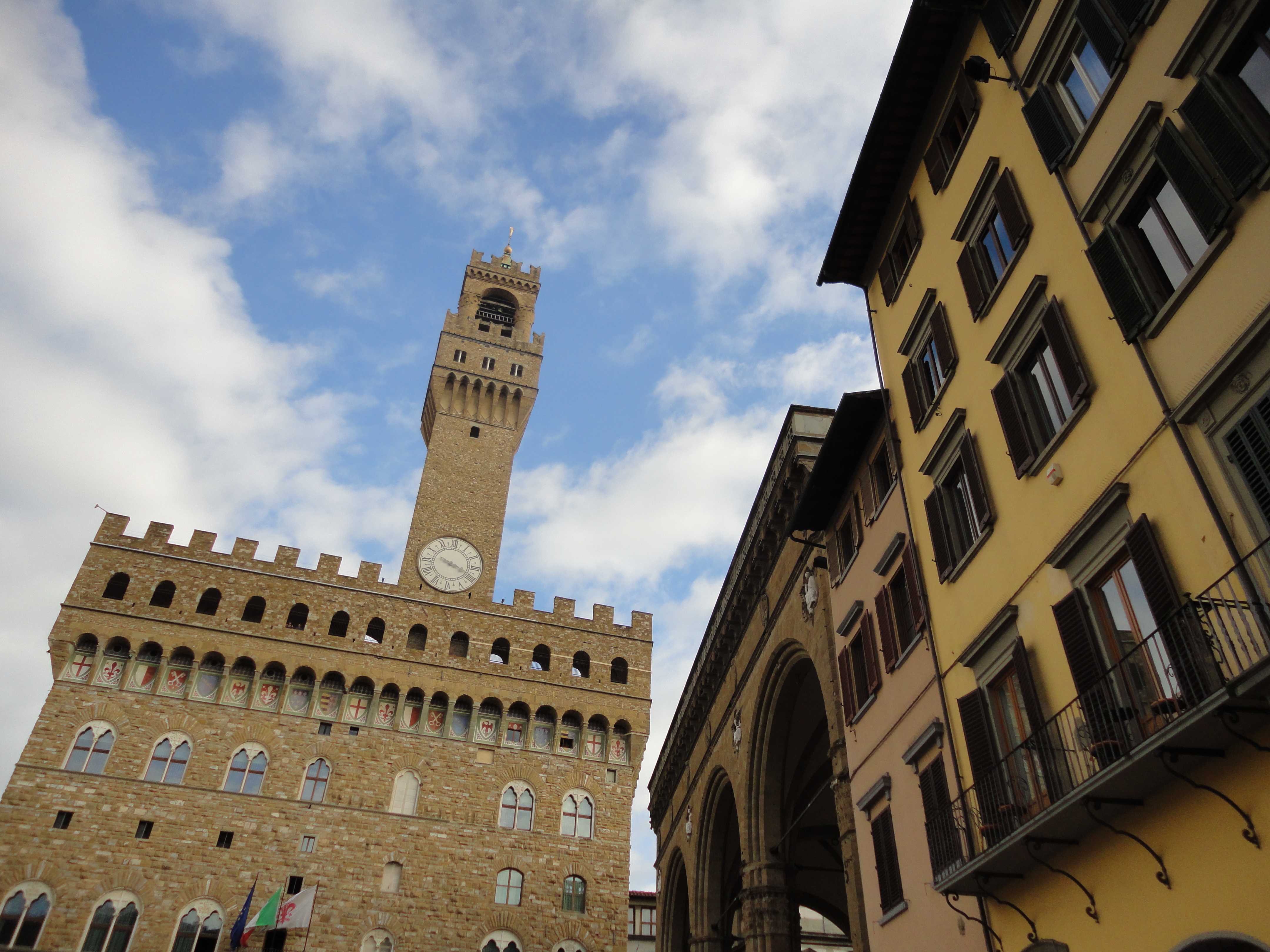
You finally make it through the gap. Then there before you flows the Arno River, and look…there!…the Ponte Vecchio, and the campanile towering over the Piazza della Signoria which you so desperately wish to reach…but once again you are drawn hopelessly into that river of traffic to repeat the vast circumnavigation of the city.

And Heaven help you if you forgot to take a toilet break before you entered this particular circle of Hell…

Because even should you venture off the ring road and enter the labyrinthine streets of the city, don’t expect to find a parking space (or a public restroom).  You’ll circle hopelessly, delving here and there into side streets in a valiant effort to find some space, any space, which can handle your compact car.  Perhaps after a half-hour or more you’ll be blessed by the Florentine gods and manage to park.

Florence crowd

Now you can fight the crowds of international tourists, pass the sidewalk displays of fake Gucci and Louis Vuitton, flinch at the boorish behavior of so many fellow travelers.  I suggest keeping your eyes focused upwards, admiring the architecture, shutting your ears to the raucous melee, and finding a quiet space within yourself to sense the beauty of your surroundings.

Piazza della Signoria

Piazza della Signoria

The solution:  Overnight in the central city.  Talk with your hotel reception about lesser-frequented places to find authentic Tuscan fare.  Leave your rental car in a parking garage and use your feet or public transport.  And lose yourself in a museum or two during the daylight hours.  Then explore the city by night when the crowds have dispersed.

florence ponte vecchio

You might just find yourself–cup of gelato* in hand–drawn to an otherwise quiet side street to stop before a crowded bar.  Inside, patrons pay rapt attention to the remarkable singer whose voice brought you there, his rich tenor coming from the heart.  And opening yours.

And perhaps you won’t hate Florence quite as much.

* Check out Grom gelato, all-natural and of highest quality ingredients:  Via del Campanile, to the right of the Duomo.

Copyright 2013 Patrick W. O’Bryon

Posted in European Travel | Tagged , , , , , , , , , | 8 Comments

Ghosts of Europe Past: Three More Haunting Tales

Our fascination with  ghosts begins in our earliest years. Perhaps as children we are more open to specters lurking just beyond our everyday reality, and as adults we begin to tune them out.  For the kid in you, here are three more haunting experiences to keep you wondering…

Domaine des Hauts de Loire

Domaine des Hauts de Loire

Onzain, France, 2005.  The Domaine des Hauts de Loire is a magnificent hostelry hidden in a vast private park, a member of the Relais & Chateaux chain of luxury inns across Europe.  The grand old chateau is surrounded by towering trees and graveled walkways, and a broad terrace offers guests the ideal spot to enjoy an evening drink or satisfying breakfast as one looks out over the lawns and the large pond.  Best of all, the famed chateaux of the Loire Valley are all just a short drive away.

But late in the evening, when the last rays have faded from the sky, when the stars begin to work their magic on the parkland below, and shadows shift in the encroaching mist, take your partner by the hand, leave the terrace, and stroll out into the darkness.  Think of the many who have experienced this place in centuries past, the lives which have seen love or sorrow or suffering where your feet now tread.  And you might just see what my sister-in-law witnessed when the four of us stayed here:

The spectral figure of a solitary woman clothed in a billowing white dress, stumbling along the far side of the pond to throw herself into the waters and escape her troubled life, leaving nothing but sorrow and her phantom image behind.

Spooky.

Berlin's Ku-Damm by night

Berlin’s Ku-Damm by night

Berlin, Germany, 1979.  A modest four-story hotel on the Kurfürstendamm, one of the few structures to survive the destruction of the city in the final days of Hitler’s Reich.  Snow falls outside, and I stand at my third-floor window beside one of my room’s twin beds, staring out at the swirling flakes.  A solid thump rocks the window, yet nothing appears in the courtyard outside to explain what caused me to step back in surprise. I sleep fitfully, troubled by strange dreams.

Blaming my bad night on jet lag, I shave the next morning at a basin, staring into a mirror on the wall.  A woman’s voice utters my name, clearly and distinctly, and directly behind me.  Beyond my image in the mirror I see no one, so I turn abruptly, expecting that somehow a maid has entered my room.  There truly is no one there.  And I realize the old wooden floorboards would have announced a visitor long before she reached my back.

At breakfast I recount my experience to the students in my tour group.  One girl who admits to a psychic gift suggests we all return to the scene to see what she senses.  Once in the room she walks directly to the window where I had stood the evening before, and she shudders.  “Something very bad happened, right here,” she states with eerie assurance, and points to the spot where I had slept.

The next evening I sleep in the other bed on the opposite wall, as far from that spot as possible.

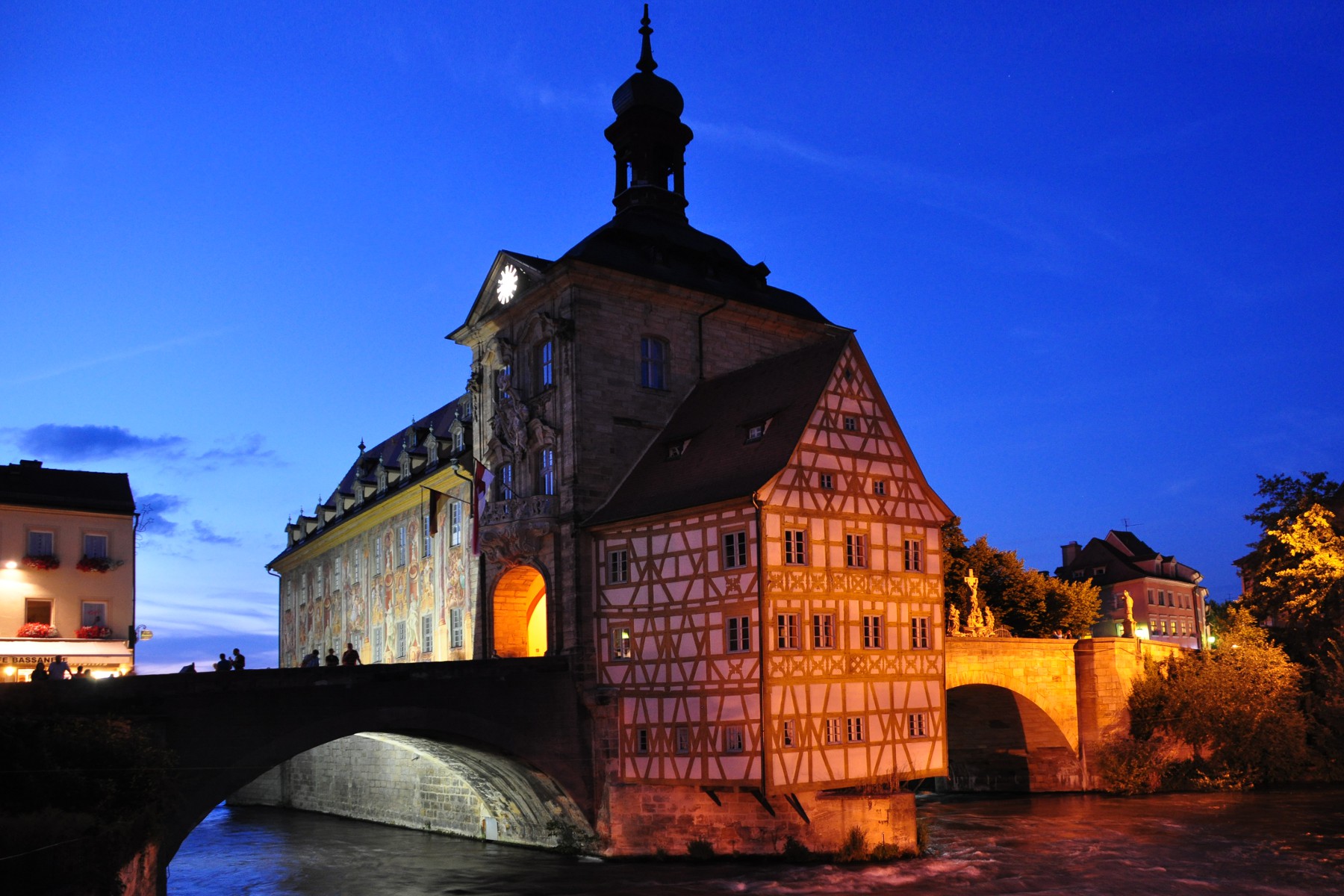
Bamberg, Germany with thanks to www.all-free-photos.com

Bamberg, Germany with thanks to http://www.all-free-photos.com

Bamberg, Germany, 1984.  Our six-member family group is traveling across Germany and Austria.  My wife and I and a sister and brother-in-law are accompanying my parents on a last tour of Europe for my ailing father, who lived and loved, reported and spied during the rise of the Third Reich and the desperate days of World War II.

We arrive in Bamberg in the late afternoon and park our VW van in a lot adjoining a hotel.  My brother-in-law and I walk toward the inn to inquire about rooms when the wrenching cry of a woman in great suffering splits the air.  We question what we truly just heard, but there is no further agonizing cry, no other sound out of the ordinary.

Three rooms are booked for the night, all side-by-side on the same landing of the second floor.  After dinner we retire for the night.  My wife and I are in the room on the right.  The center room holds my parents.  Our sister and her husband  reside to the left.

I am jarred out of sleep by a great ruckus out on the landing, and recognize  my father’s voice calling out in fear and distress.  He is at the stairway, trying to run down and out into the night, screaming that everyone is trying to kill him.  My mother, who has tried to restrain him, is drenched in sweat and her heart misfires.  She can barely stand as she struggles with tachycardia.  My brother-in-law is attempting to  bring my father to his senses with words of reassurance, since he is the only one my father seems to believe is not trying to harm him.  My sister, having jumped quickly out of bed, is light-headed and collapses in a faint at her door.

And all the while, strangers are struggling with racks of fur coats as they fight their way up the stairway in preparation for a fur show scheduled at the hotel for the next day.  The furriers stare at our strange gathering as they race past, but say nothing and move on their way.

Gradually, my father is brought to a clearer mind, my mother is back in bed, her racing heart calmed enough for her to breathe normally again, my brother-in-law—his great service done—returns to my sister in their room, and I tell my wife that I will spend the rest of the night in a chair by my parents’ bedside, just in case.

My wife—never one prone to nightmares of this kind—dreams horrifying images of blood-soaked walls and sharp, bloodied blades entering the room from all directions.

In the morning we sit below in the breakfast room and try to speak of other things.  The waiter brings coffee and asks how we slept.

“A bit troubled,” I say.

He bends close to whisper:   “You do know this was Gestapo headquarters during the war?”

Copyright 2013 Patrick W. O’Bryon

Posted in European Travel, Travel Memoir | Tagged , , , , , , , , , , , , , , , , , , , , , | 2 Comments

HOW TO RISK A STRETCH IN SOVIET PRISON AND STILL HAVE FUN: A Prague Adventure

Have I ever mentioned  flirting with years in a Soviet prison for breaking the law  with a baker’s dozen university students behind the Iron Curtain?  No?  Well, the story goes something like this…

Late in the ‘70’s I was teaching German studies when the opportunity to spend a winter semester in Europe presented itself, paid for by the generous parents of the students.  My wife—prescient as always—imagined traipsing past Kalashnikov-wielding guards and interminable customs inspectors with college students in tow a less than  relaxing vacation, especially in the frigid hold of January.  She suggested I go it alone.  Alone, except for those twelve girls and the one guy who signed up for my tour of West and East Berlin, Prague, Vienna and Munich.

We arrived in divided Berlin on the heels of a massive winter storm and found the city sheathed in snow and ice.  After a day getting our internal time-clocks back on track, we gathered in the pre-dawn cold to board the S-Bahn elevated railway and glide through the darkness into the Soviet bloc.  Armed East German guards stood to either side of the bridgehead over the Spree River, and at the first stop we were ordered off the train to enter a stuffy, overheated holding room.

Berlin-Wall-Sign-3

I glanced around somewhat nervously as the imperious customs inspector worked her way page by page through each of our passports and visas.  It was obvious she hoped to find something out of order which would bring our grand tour to a screeching halt.  But all was good, and—that test passed—we were rudely instructed by more armed guards to move single-file through a gate to long tables where our luggage was exposed to the world.  More inspectors searched through every nook and cranny for contraband.  No smiles, no banter, just gruff and intimidating demands.  One of my students was forced to surrender her copy of Shape magazine purchased at the Berlin airport…too explicit photography for East Germany, or perhaps too tempting as future ogling material for the young inspector.  Forty-five minutes later we were allowed to re-board the S-Bahn for transport to the train terminal, where we caught our express for Prague.

As the day broke to overcast skies and more snow threatening, our train rolled through magnificent country of rolling hills and mountains and beautiful frozen rivers.  We noted at every stop that drably-dressed locals boarded the train, but never entered our car.  In fact, we had our rail car all to ourselves, with the exception of a young German man who sat at the very rear.  By watching closely, we saw that any passenger attempting to enter our carriage was directed to a neighboring car.  Our one fellow passenger was obviously not there by accident, and my students thought to have some fun with him.

Two co-eds plopped down next to the young man in his poorly-fitted suit and struck up a conversation.  “Do you speak English?” “Have you been to America.” “Would you like to show us Prague?” With every question he blushed more sheepishly and glanced repeatedly toward the windowed door to the front vestibule.  He said not a word, braved a brief smile or two, and looked utterly helpless.

At the next stop he left our car and never returned, to be replaced by an older man, who appeared to find his bad suits at the same shop.  The girls decided to have their fun with him, as well, and he too eventually succumbed to their infectious smiles and enthusiasm and uttered a few words in broken English.  At the following stop our new “traveling companion” was a sour-faced middle-aged woman who stared directly ahead and refused to respond to any greetings.

And as evening settled over the Vltava River, our train pulled into the Prague train station.  We gathered up our luggage and made our way to the taxi stands past roving soldiers with Kalashnikovs shouldered, always in pairs.  Very welcoming.

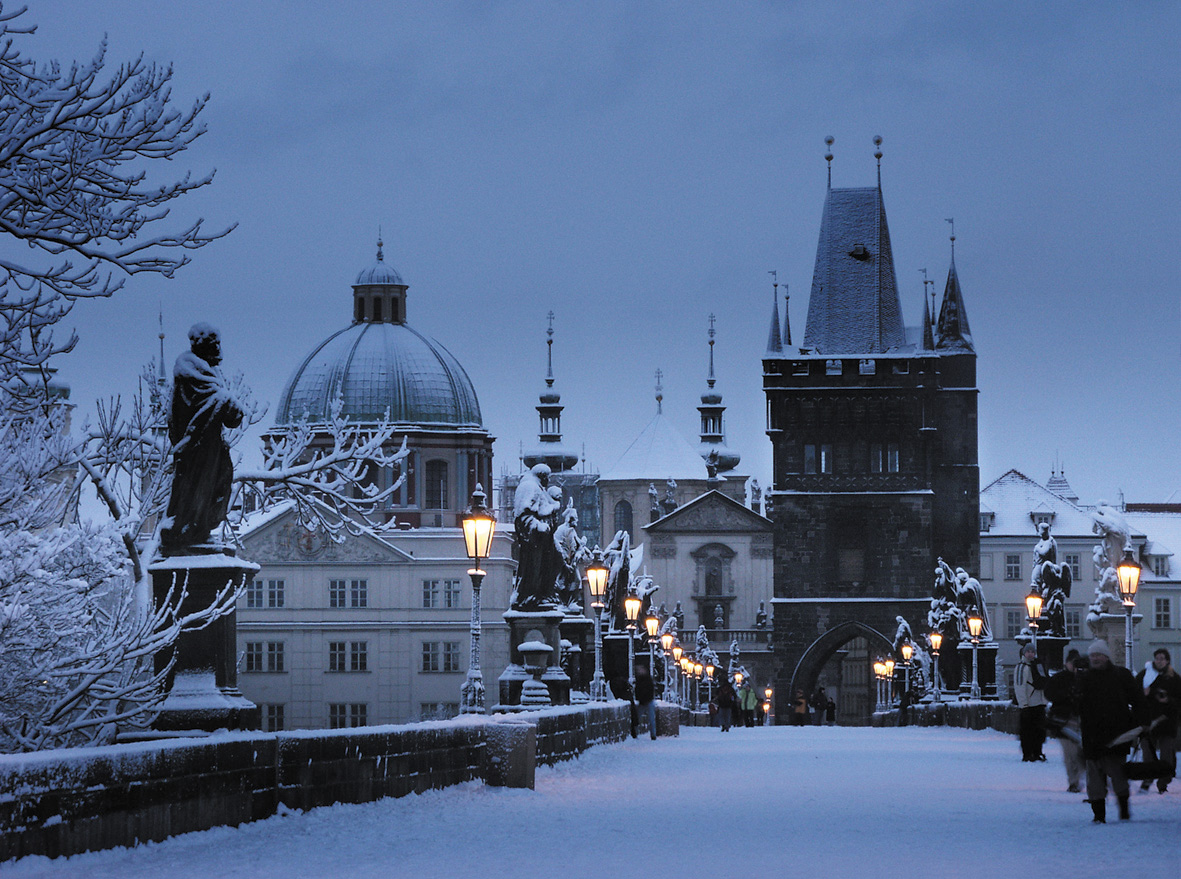
Imagine without the glow of lanterns and under the spell of full moon

Imagine without the glow of lanterns and under the spell of full moon

Now picture this:  the storm which brought such ice and snow to Germany and Eastern Europe that January also brought a massive countrywide power blackout, and the most wondrous beauty.  Prague by night, lacking electricity and enveloped in a blanket of white now glimmering under clear skies and a full moon.  A mirage of the seventeenth century.  No streetlamps, only the glow of candles and lantern light from behind curtains and drapes.  And giving imagination free rein, you could pretend that the lights from the few taxis plowing their way cautiously through the icy streets were carriage lanterns.  It was magical.

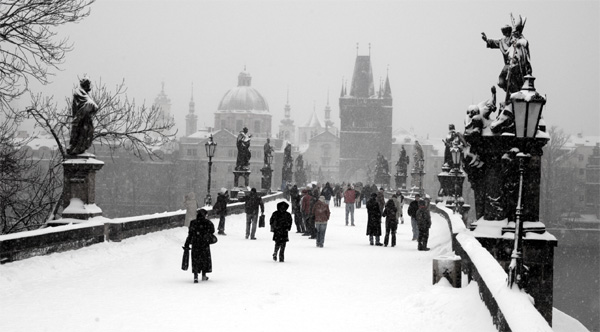
For several days we wandered the enchanting old city, crossed and re-crossed the Charles Bridge over the Vltana, climbed high to the castle, drank great beer at U-this and U-that.  We admired the architecture, visited the hangouts of Franz Kafka, strolled museums while bundled to the teeth in heavy coats and scarves.  And never lost track of our follower, our minder, the discreet fellow who traced our steps through the snow, always keeping a bit of distance, never making contact.

Evenings we sat in restaurants with many-paged menus listing a wide and inviting selection.  But we quickly learned that it was all for show.  If one asked for goulash, the kitchen was temporarily out.  If one requested a salad, they had just served the last one.  So at almost every meal we had fatty chunks of pork in gravy served with a large dumpling or steamed potatoes and plenty of cabbage.  And there was cabbage soup with a little bacon, as well.

Prague_during_winter

Each room in our hotel had a radio installed in the wall above the bed, and each radio had one station only…the state-run station.  You could turn down the volume, but not switch it off entirely.  Even the elevators were tuned to the latest propaganda.  While dressing one morning I stopped abruptly as—buried in the unintelligible Czech reporting—I heard my own name mentioned.  Once dressed and in the elevator, I asked the operator (who spoke good English and was grumpy in public, but magically transformed once we were alone in the cabin) if he had happened to note the mention of my name.  “Yes,” he said, “You should know that you are here in Czechoslovakia to show American college students the wonders of the Communist state.”   How nice to learn I was doing my part.  He revealed that he had held a top political position in the Czech government during the brief liberalization of the 1968  “Prague Spring,” but after the Soviet tanks rolled in he could now only find work as an elevator man.

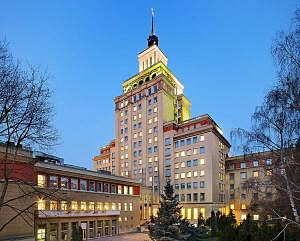
On our last evening in Prague we gathered high atop the Hotel International (now Holiday Inn Crowne Plaza), a 1950’s Socialist Realism landmark and one of the few designed solely for foreign visitors.  Thus it was one of the few with a restaurant overlooking the city and offering more than  the drab monotony of fatty pork and dumplings with cabbage.  Since it was strictly forbidden to take a single crown of Czech currency out of the country, we all pulled our coins and bills from pockets and handbags and once the bill was settled piled them high on the table as a momentous tip for our servers.

The former Hotel International  in Prague

The former Hotel International in Prague

The next day we boarded the train for Vienna.  The girls befriended a young Austrian paper-products salesman, Johann, who often traveled between Vienna and Prague on business.  As we approached the border the train squealed to a halt in the countryside, far from any station.  We heard shouting outside along the cars, and watched as bayonet-wielding soldiers moved from car to car, stabbing the long blades up into the undercarriage and in between the diaphragms joining the rail cars as they sought out potential escapees from the “wonders of the Communist state.”  Next the soldiers boarded our car and moved along from seat to seat, demanding that all passengers open their luggage.

I glanced back as a great ruckus arose around two of my charges, and went to see what was happening.  Two girls were being arrested for attempted currency smuggling, and perhaps I as their leader put them up to it?  Sure enough,  monetary souvenirs had been hidden in the students’ bags! Visions of Soviet gulags.   How to explain to the parents that I and two of their little darlings would have an extended visit in the Soviet bloc?

I tried to explain in German that no harm was intended, but the officials were buying none of it.  The law is the law.  And then came the girls’ Austrian knight.  The paper-products salesman interceded with his perfect command of Czech.  As a frequent traveler on the route he knew the soldiers by name, and soon had them laughing at the stupidity of Americans.

And we breathed a sigh of relief as we crossed the border into Austria.

I came down with a cold, my immune system surely compromised by the stress.  My student charges?  They had a nice evening out with Johann, enjoying a glass or two of new wine at a Heuriger.  I paid.  Cheaper than Soviet bail, I was sure.

photo (13)


Copyright 2013 Patrick W. O’Bryon

Posted in Travel Memoir | Tagged , , , , , , , , , , , , , , , | 6 Comments